Tarot or Sibyl cards? Differences and which reading to choose
Two different symbolic languages: how tarot and Sibyl cards work, what sets them apart, and which reading to choose for the question you want to ask.
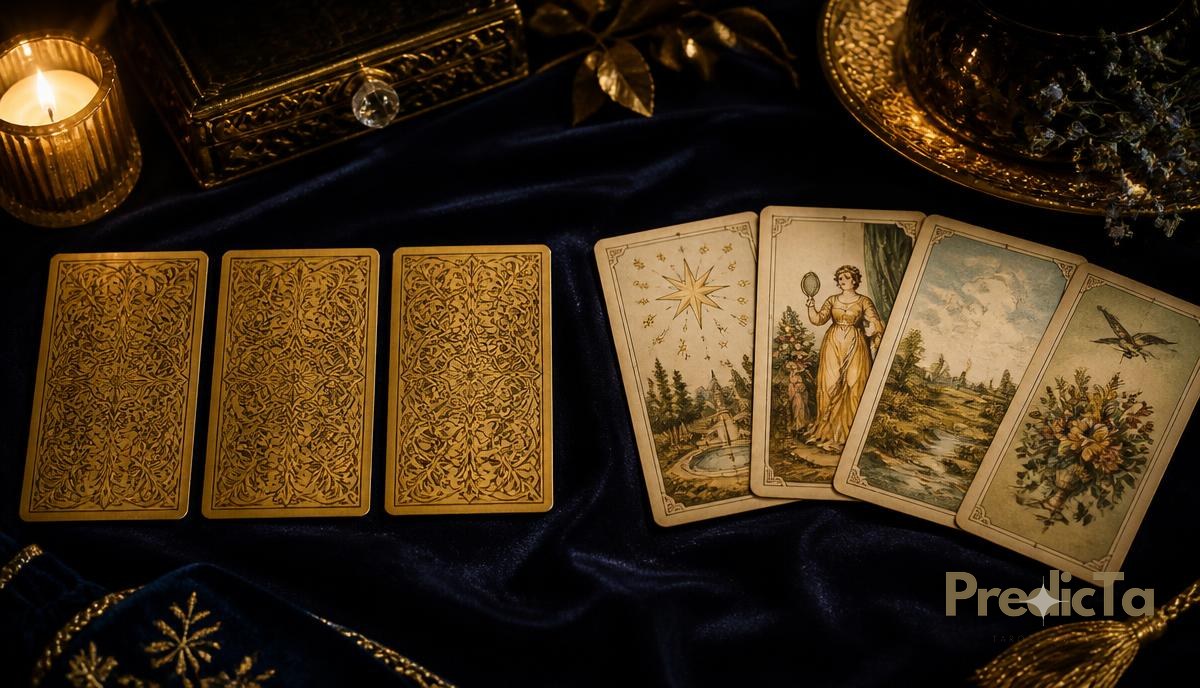
Tarot and Sibyl oracle cards are often mentioned in the same breath, but they are not the same thing.
Both can be used in cartomancy to explore a question or a situation, but they do it through different symbolic languages.
Tarot tends to build a reading rich in archetypes, passages and inner dynamics. Sibyl cards use images and scenes that are generally more immediate, tied to everyday life, relationships and events.
That does not make one tool better than the other.
The more useful question is: which of the two suits what I want to understand?
What is the difference between tarot and Sibyl cards?
The clearest difference concerns the structure of the decks and their language.
A traditional tarot deck is made of 78 cards, divided into 22 Major Arcana and 56 Minor Arcana.
The Major Arcana represent great archetypes and passages of human experience; the Minor Arcana let you go further into the dynamics and situations surrounding the question.
Sibyl cards belong to a different tradition. Their images tend to portray people, situations, behaviours and circumstances in a more direct way.
That difference inevitably shapes how a reading is built.
When to choose tarot
Tarot is particularly suited to understanding a situation as a whole.
It can be useful for questions such as:
- “What is the real dynamic of this relationship?”
- “What is holding me back?”
- “Which direction could this situation take?”
- “What should I understand before making a decision?”
- “What is the potential of this relationship?”
Its strength is the ability to connect several levels of the same situation.
One card may speak of emotion, another of an obstacle, another of a possible development. It is the dialogue between the cards that builds the overall meaning.
When to choose Sibyl cards
Sibyl cards can be especially interesting when the question concerns concrete situations, behaviours, relationships and everyday dynamics.
Their visual language is often more immediate.
They can be used, for example, to explore:
- a romantic situation;
- a conversation that has broken off;
- a meeting;
- a person who has withdrawn;
- a family dynamic;
- a work matter;
- what seems to be moving around a concrete situation.
This does not mean Sibyl cards automatically give more certain answers. It simply means they tell the story through a different language.
Tarot or Sibyl cards for love?
Both can be used for a love question.
The choice mostly depends on what you want to know.
If you want to explore the deeper meaning of a bond, the feelings, the obstacles and how the relationship might develop, you may prefer tarot.
If you would rather look at a romantic situation through behaviours, people, contacts and more concrete circumstances, the language of Sibyl cards may feel more immediate.
For instance, a question like “What is the emotional dynamic between us?” lends itself very well to a tarot reading.
A question tied to what is concretely happening in the relationship can be interesting to observe through Sibyl cards.
There is no rigid divide, though. A lot depends on the kind of reading you feel closer to.
Do tarot and Sibyl cards read the future?
It is an important question, because it concerns both.
Neither tarot nor Sibyl cards should be treated as tools capable of certifying an unchanging future.
A reading can show dynamics, possibilities, obstacles and directions present at the moment it is made.
But people make decisions. Circumstances change. A relationship can evolve differently from what seemed most likely.
That is why it is more useful to read a spread as a dynamic snapshot of the situation rather than as a sentence.
Can I ask the same question to tarot and to Sibyl cards?
Yes, but doing it immediately just to see whether they “give the same answer” rarely helps.
The two systems use different languages and can highlight different aspects of the same situation.
If you do a tarot reading and then repeat the question to the Sibyl cards hoping for a more favourable answer, you turn the consultation into a search for reassurance.
What does make sense is using the two tools with complementary questions. For example, to tarot: “What is the deep dynamic of this relationship?”; to the Sibyl cards: “Which concrete dynamics are influencing this situation today?”
That way you are not asking the same thing twice: you are looking at the situation from two different perspectives.
Which deck is easier to interpret?
At first glance Sibyl cards can seem more immediate, because many images depict recognisable situations.
Tarot uses a more articulated symbolic system.
But in both cases a single card only tells part of the story.
The position of the card, the question and the other cards in the spread all change the meaning.
This is why reading a card through a fixed definition taken from a list is rarely enough.
A reading is born from the relationships between the cards.
The question matters more than the deck
Before deciding between tarot and Sibyl cards, it is worth asking what you really want to understand.
A generic question such as “What will happen?” leaves an enormous field open.
A question like “What is preventing this relationship from moving forward?” pinpoints a precise aspect.
The quality of the question can therefore affect the reading at least as much as the choice of deck.
If you want to go deeper into this, read “How to ask the tarot a question: examples, mistakes to avoid and questions that work”.
On Predicta you can choose either reading
Predicta offers both the tarot reading and the Sibyl cards reading.
You do not have to decide which system is “better”.
You can choose the one that feels closest to the question you want to ask.
With tarot you can work on a more symbolic, layered reading of the situation.
With Sibyl cards you can explore it through a different language, often closer to people, behaviours and circumstances.
In both cases, the question remains the starting point.
Tarot or Sibyl cards: which should you choose?
If you are still undecided, use a very simple distinction.
Choose tarot if you mainly want to understand the meaning, the dynamic and the possible evolution of a situation.
Choose Sibyl cards if you prefer to look at people, behaviours and circumstances through a more direct language.
It is not an absolute rule.
It is simply a way of working out where you want to start.
Choose the reading that feels right for your question.
Frequently asked questions
- What is the difference between tarot and Sibyl oracle cards?
- They are different cartomancy systems in structure, imagery and symbolic language. Tarot uses a traditional 78-card deck and an articulated symbolic system; Sibyl cards tend to depict people and situations through more immediate images.
- Are oracle cards more accurate than tarot?
- No system is objectively more accurate. The two decks can highlight different aspects of a situation, and the quality of a reading also depends on the question, the spread and how the cards are interpreted as a whole.
- For love, is tarot or an oracle deck better?
- Both can be used for love questions. Tarot is particularly suited to exploring emotions, dynamics and possible developments, while Sibyl cards can offer a more immediate language for people, behaviours and concrete situations.
- Can I ask the same question to both decks?
- Yes, but repeating the same question straight away just to get a different answer is rarely useful. It is more interesting to use the two decks to explore complementary aspects of the same situation.
- How many cards are there in a tarot deck?
- A traditional tarot deck contains 78 cards: 22 Major Arcana and 56 Minor Arcana.
- Do I need to know the meaning of the cards to have a reading?
- Not necessarily. What matters is that the interpretation takes into account the question, the position of the cards and the relationships between them, rather than the isolated meaning of each single card.